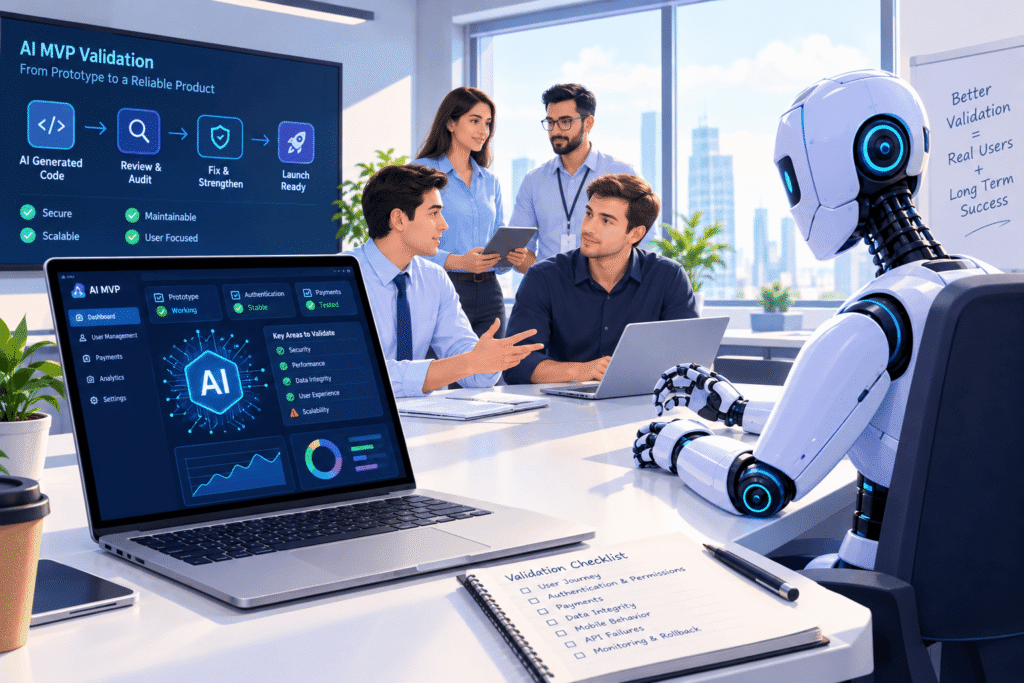
The best agencies for auditing AI built apps know what many founders learn once the demo is working: generated code can make a product look convincing long before it becomes dependable. Authentication might work, payments may go through, and the dashboard can look polished, while duplicated logic, exposed secrets, weak database rules, and missing test coverage are still lurking underneath.
Our team has reviewed fast builds made with AI coding assistants, low-code platforms, and mixed human-AI workflows. The best products usually don’t need a full rewrite. They need an evidence-based audit that separates safe code from urgent risks and lays out a practical remediation plan.
Why Auditing AI-Built Software Requires Different Skills

Auditing an AI-built application takes engineers who can reconstruct development decisions that were never documented.
Generated code can look fine when you review one file at a time. The trouble often appears between systems: two modules may handle authorization differently, API routes may trust client-side input, and database migrations may no longer match the current schema. We’ve also found placeholder configuration still running in production because no one checked the full deployment path.
- Repeated components make straightforward changes costly and inconsistent.
- Packages may be unnecessary, outdated, or added without a license review.
- Business rules can end up in UI components rather than a controlled backend service.
- Model prompts, API keys, or personal data may be logged without proper safeguards.
- Happy-path testing can miss payment, permission, and recovery failures.
An agency needs skills in architecture, DevOps, application security, UX, and software quality assurance. Founders getting ready to launch can also use our process to validate an AI-built MVP before committing to a large repair budget.
What A Credible AI Application Audit Covers
A credible audit reviews business-critical user journeys alongside code quality, security, infrastructure, data integrity, and maintainability.
We usually start with a 60 to 90 minute product walkthrough and repository access. Engineers then run the application locally, inspect deployment environments, trace core workflows, and rank findings by severity and business impact. Automated scanners are useful, but tools such as SonarQube, Snyk, OWASP ZAP, Semgrep, Lighthouse, and GitHub Actions don’t replace manual engineering judgment.
- Architecture: boundaries between the UI, APIs, database, background jobs, and external services.
- Security: authentication, authorization, secret handling, input validation, dependencies, and OWASP risks.
- Data: schema quality, tenant isolation, backups, migrations, retention, and sensitive-data exposure.
- Quality: unit, integration, API, and end-to-end coverage for critical workflows.
- Operations: CI/CD, monitoring, rollback procedures, environment separation, and cloud costs.
- Product experience: accessibility, responsive behavior, error states, onboarding, and performance.
The deliverable should include reproducible evidence, risk ratings, recommended fixes, effort ranges, and a sensible order of execution. Generic warnings aren’t very helpful if they don’t show which failures could block launch or harm customers.
Best Agencies For Auditing AI Built Apps
The best agencies for auditing AI built apps pair an independent assessment with the engineering capacity to stabilize, refactor, test, and modernize a product.
This shortlist draws on each company’s publicly described capabilities in software auditing, AI engineering, quality assurance, security, or application modernization. The right fit still comes down to your product stage, industry, stack, and budget.
| Company | Best For | Key Strength |
|---|---|---|
| Zluck Solutions | Startup MVPs and growing SaaS products | Practical audits followed by focused remediation |
| ELEKS | Detailed enterprise software assessments | Structured coverage of architecture, security, UX, and process |
| Netguru | Products needing modernization planning | Prioritized roadmaps with risk and effort estimates |
| Vention | Teams expanding AI-enabled quality engineering | Integrated development, QA, and modernization capabilities |
| Thoughtworks | Complex enterprise platforms | Incremental modernization and architecture expertise |
Zluck Solutions
Zluck Solutions is a good fit for founders who used AI-assisted development to get a working MVP and now need senior engineers to identify what is safe to keep. Our reviews tie code findings to launch priorities, including authentication, payments, data integrity, performance, and the product’s main user outcome.
Key strength: Moving from audit to focused fixes without treating every concern as a rebuild. Best fit: Startups, SaaS teams, marketplaces, and operational platforms that need a hands-on partner familiar with AI-assisted software development.
ELEKS
ELEKS provides dedicated software audit services across architecture, databases, code quality, integrations, security, UI/UX, documentation, and testing artifacts. Its structured approach can work well when leadership needs a formal assessment that also looks at delivery processes.
Key strength: Broad, methodical audit coverage. Best fit: Established organizations, regulated products, or teams that need a detailed remediation roadmap.
Netguru
Netguru approaches application modernization by assessing codebases, infrastructure, and engineering workflows before recommending changes. Its work includes automated testing, CI/CD, cloud-native systems, and incremental decomposition.
Key strength: Linking technical debt findings to a staged modernization plan. Best fit: Products where AI-generated modules now sit within an older or increasingly constrained architecture.
Vention
Vention brings together quality engineering, application modernization, security services, and AI-focused software delivery. Its quality engineering offering is especially relevant when an internal team needs stronger validation workflows as AI increases development output.
Key strength: Embedding QA in the engineering environment. Best fit: Mid-market and enterprise teams that need additional engineering capacity and repeatable quality gates.
Thoughtworks
Thoughtworks suits large platforms where audit findings may lead to broader product or legacy modernization work. Its public approach emphasizes stabilizing current systems, incremental change, test-first practices, and scalable architecture.
Key strength: Managing complex modernization programs with major organizational dependencies. Best fit: Enterprises where an AI-built feature or product connects with business-critical systems.

Questions To Ask Before Selecting An Audit Partner
The right questions show whether an agency can assess your application independently and give your team decisions it can use.
- Will senior engineers inspect the repository, infrastructure, database, and live user journeys?
- Which automated and manual application security testing methods will be used?
- Will findings include evidence, severity, business impact, and estimated repair effort?
- How will you detect hallucinated dependencies, duplicated logic, and inconsistent authorization?
- Can we keep the report and use another team for implementation?
- How do you protect source code, credentials, customer data, and proprietary prompts?
- Can fixes be delivered incrementally while the existing product remains available?
Ask to see a sample report with confidential details removed. It should separate immediate release blockers from medium-term technical debt. A capable partner should also explain when refactoring is enough and when application modernization is the safer investment.
What Happens After The Audit
A useful audit ends with a sequenced stabilization plan that protects customers first and improves maintainability over time.
We typically group remediation into three bands. The first handles critical security, payment, permission, and data-loss risks. The second improves reliability through automated tests, logging, error handling, and deployment controls. The third addresses structural debt through refactoring, documentation, UX refinement, and performance optimization.
For a focused MVP, an assessment may take several working days, while stabilization commonly takes two to six weeks depending on scope and severity. The agency should set measurable completion criteria, such as critical workflows passing end-to-end tests, zero exposed secrets, verified tenant isolation, and a tested rollback procedure.
Start With A Focused Independent Review
A focused independent review gives founders enough evidence to decide whether to repair, modernize, or keep building the current application.
Good audit agencies preserve progress that is already sound while making risks visible before users, investors, or enterprise customers find them. If you have a working AI-built product and need a clear assessment of its code, security, architecture, performance, and launch readiness, request a free quality review with Zluck Solutions.
Frequently Asked Questions
How long does an audit of an AI-built application take?
A focused MVP audit often takes several working days. Larger platforms may need two or more weeks because the team has to review multiple environments, integrations, user roles, data flows, and infrastructure. In our experience, repository size alone is a poor guide. Undocumented workflows and inconsistent architecture usually create the extra work.
Does AI-generated code always need to be rewritten?
No. We often find usable components alongside a few isolated high-risk areas. A good audit shows what can stay, what should be refactored, and what needs to be replaced. Rewriting everything can create fresh defects and use budget that would be better spent on security, testing, monitoring, and critical user journeys.
What are the most common risks in AI-built apps?
Common issues include inconsistent authorization, exposed credentials, weak input validation, duplicated business logic, unnecessary dependencies, missing database constraints, poor error handling, and limited automated test coverage. Model-enabled products can also expose sensitive prompts or user data through logs and third-party API calls.
Should the agency that performs the audit also fix the application?
It can, as long as the audit stays evidence-based and the report belongs to you. Ask for severity ratings, reproducible findings, and effort ranges before approving implementation. That gives you options and helps prevent vague recommendations from driving the remediation scope.
What access does an application audit team need?
The team generally needs read access to the source repository, dependency files, database schema, deployment configuration, monitoring tools, and a safe test environment. Production access should stay limited and controlled. Our team starts with the least privilege needed and doesn't copy customer data into local or AI-assisted tools.