The best WordPress development agencies combine reliable engineering, thoughtful design, transparent communication, and post-launch support – not simply an attractive portfolio. In our experience delivering custom WordPress projects, the most expensive mistakes usually begin before development: unclear requirements, an unsuitable technical approach, or selecting a team based only on price. This guide compares six agencies with distinct strengths so you can create a shortlist that fits your website, business model, and internal resources.
Why Choosing a WordPress Agency Is Surprisingly Difficult
Choosing a WordPress agency is difficult because hundreds of providers advertise the same capabilities while delivering very different levels of strategy, code quality, testing, and support. WordPress powered 40. 2% of all websites measured by W3Techs on September 24, 2026, so the ecosystem includes everything from solo page-builder specialists to enterprise engineering teams. w3techs.com
We regularly inherit websites that look acceptable but are difficult to maintain because the previous team installed overlapping plugins, edited third-party themes directly, or skipped mobile QA. The best WordPress development agencies make architectural decisions based on expected traffic, editorial workflows, integrations, compliance needs, and who will manage the website after launch. A small marketing website does not need enterprise infrastructure, while a multisite publishing network should not be treated like a brochure site.
What the Best WordPress Development Agencies Should Prove
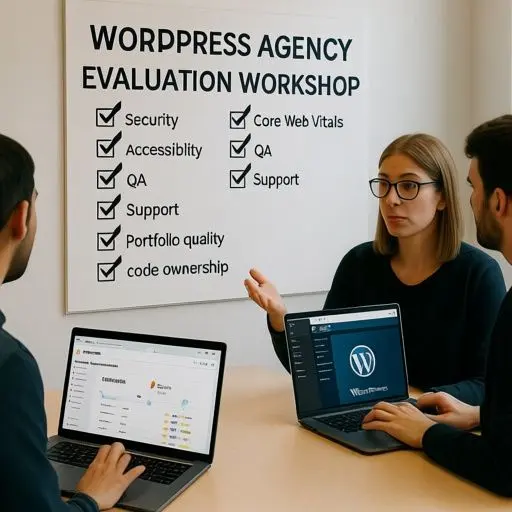
The right agency should prove that it can protect performance, security, maintainability, and business continuity throughout the website lifecycle. Before requesting proposals, use the following criteria to separate polished sales presentations from genuine delivery capability:
- Relevant work: Ask for live websites with comparable traffic, features, integrations, or publishing requirements – not screenshots alone.
- Technical clarity: The team should explain when it would use Gutenberg, Advanced Custom Fields, WooCommerce, custom plugins, REST APIs, or a headless architecture.
- Performance discipline: Ask how Core Web Vitals, image optimization, caching, database queries, Cloudflare, and third-party scripts will be tested.
- Security and QA: Confirm the process for staging, code review, vulnerability updates, regression testing, backups, and role-based access.
- Ownership and support: Verify that you receive source code, documentation, administrator access, training, and clear post-launch service terms.
Our guide to choosing the right WordPress development partner includes practical questions for your first agency call. We also recommend requesting a sample project plan. On well-run builds, discovery, UX, development, content entry, QA, migration, and launch are visible stages rather than one vague delivery promise.
Best WordPress Development Agencies to Shortlist in 2026
The best WordPress development agencies for 2026 include Zluck Solutions, 10up, Human Made, rtCamp, Multidots, and XWP, but each is best suited to a different type of engagement. This is a fit-based shortlist rather than a universal ranking.
The following comparison summarizes where each agency is likely to be strongest:
| Company | Best For | Key Strength |
|---|---|---|
| Zluck Solutions | SMBs and growing companies | Flexible custom delivery |
| 10up | Enterprise content platforms | Open-source engineering |
| Human Made | Global organizations | WordPress at scale |
| rtCamp | Complex enterprise builds | Large engineering capacity |
| Multidots | Publishers and migrations | CMS replatforming |
| XWP | High-traffic publishers | Performance engineering |
1. Zluck Solutions
Zluck Solutions is best suited to startups, SMEs, agencies, and established businesses that want direct access to a multidisciplinary team without enterprise-agency overhead. We have delivered more than 100 WordPress projects, including custom ACF builds, WooCommerce stores, redesigns, platform migrations, custom functionality, and ongoing maintenance. Our strongest fit is a business that values practical recommendations, responsive communication, and long-term support from an in-house team. zluck.com
2. 10up
10up is a strong option for enterprise publishers, institutions, and content-heavy organizations. Now operating as the enterprise WordPress practice of Fueled, it focuses on digital strategy, content management solutions, open-source technology, and complex online experiences. Its portfolio and maintenance capabilities make it appropriate when governance, publishing workflows, and round-the-clock reliability matter more than keeping the initial budget small. 10up.com
3. Human Made
Human Made should be considered for global enterprise platforms, multisite networks, multilingual publishing, and organizations with demanding security or governance requirements. The company has focused on enterprise WordPress since 2011 and highlights experience with major media brands and financial organizations. It is likely to be more agency than a small brochure website needs, but it belongs on serious enterprise shortlists. humanmade.com
4. rtCamp
rtCamp is well positioned for large-scale WordPress engineering, multi-brand environments, backend integrations, and decoupled implementations. Its emphasis on governed open-source infrastructure makes it relevant to businesses with complex editorial operations or internal development teams. If headless WordPress is under consideration, first confirm that its additional hosting, deployment, and preview complexity solves a real business problem. Our guide to build a headless WordPress website with React.js explains what that architecture involves. tollbit.rtcamp.com
5. Multidots
Multidots is a notable choice for publishers and enterprises moving large content libraries from legacy platforms into WordPress. Its positioning centers on enterprise migrations, multisite environments, high-traffic websites, and publishing workflows. Migration experience matters because URL mapping, metadata, redirects, analytics, and launch sequencing can determine whether a redesign preserves years of search visibility. Review how to redesign a website without losing organic traffic before approving any migration proposal. multidots.com
6. XWP
XWP is a strong candidate for performance-sensitive publishers and media platforms where publishing speed, infrastructure cost, and traffic capacity are measurable priorities. Its published case studies emphasize outcomes such as faster editorial workflows, page-speed improvements, traffic growth, and reduced platform costs. That results-oriented positioning makes XWP especially relevant when performance engineering is central to the business case. xwp.co
How to Make the Final Decision
The best final decision comes from comparing agencies against your actual risks and operating model rather than selecting the most recognizable name. We use a simple four-step process when helping clients define a realistic engagement:
- Define the outcome: State whether success means more qualified leads, faster publishing, easier maintenance, better checkout conversion, or a safer migration.
- Identify technical risk: Document traffic peaks, integrations, user roles, accessibility obligations, multilingual content, and SEO dependencies.
- Score the shortlist: Weight relevant experience, proposed architecture, communication, QA, support, timeline, and total ownership cost.
- Test the relationship: Use a paid discovery sprint, audit, or prototype when the main project is complex or business-critical.
Do not compare proposals by total price alone. Check what each estimate excludes, who will perform the work, and whether maintenance is included. If your team cannot manage updates and monitoring internally, review the agency’s WordPress maintenance packages before launch rather than after the first urgent problem.
Getting Started with the Right WordPress Team
Start with a scoped discovery call that clarifies business goals, users, content, integrations, constraints, and success metrics before anyone recommends a theme or technology stack. The best WordPress development agencies will sometimes challenge your requested solution because their responsibility is to solve the underlying problem, not merely complete a feature list.
Zluck Solutions is included in this comparison, so our perspective is not entirely neutral. However, the practical recommendation remains the same: choose the team whose proven experience, process, communication style, and support model match your project. If you need a custom build, redesign, WooCommerce store, migration, or technical audit, you can book a free WordPress consultation to discuss the safest next step.
Frequently Asked Questions
How much does it cost to hire a WordPress development agency in 2026?
Costs depend on design complexity, page count, integrations, migration risk, and support requirements. From our project experience, a custom small-business website commonly starts around $5,000, while complex WooCommerce, membership, multisite, or enterprise projects can reach six figures. Compare scope and ownership cost rather than hourly rates alone.
How long does a professional WordPress project take?
A well-scoped business website usually takes 4 to 8 weeks, while custom platforms and large migrations can require several months. In our experience, delayed content, slow approvals, and unclear integration requirements affect schedules more often than writing the core templates.
Should I choose a local WordPress agency?
Not necessarily. A distributed agency can work effectively when it provides overlapping working hours, clear project ownership, regular demonstrations, and documented communication. We recommend evaluating responsiveness and delivery processes instead of using location as the main quality signal.
What should a WordPress agency provide after launch?
A responsible agency should provide administrator access, source code, documentation, training, backups, deployment notes, and a defined support option. Our team also recommends scheduling post-launch monitoring because caching, analytics, forms, redirects, and third-party integrations should be verified using real production traffic.
Do I need headless WordPress?
Most standard marketing websites do not need headless WordPress. It becomes useful when WordPress must supply content to multiple frontends, support a React or Next.js application, or meet unusual performance and interaction requirements. We have found that conventional WordPress is often easier and less expensive to maintain when these needs are absent.