When you choose tech stack for saas startup, start with the product, the team, and the business constraints – not the latest trendy framework. Our team has built six SaaS apps in the past five years, and the single biggest mistake founders make is selecting tools for buzz instead of fit.
Start with product goals, team skills, and runway
Before a single line of code: write down your business model, core user flows, and what “done” looks like for the first 90 days. Are you building an internal tool for a niche market, a public-facing growth SaaS, or a data-heavy analytics product? Each needs different priorities: time-to-market, performance, or data pipelines.
From experience, align tech choices with the team’s strengths. If your founding engineer is a senior Node. js dev, it’s often faster and cheaper to stay in that ecosystem than to retool them into Rust or Elixir – unless those languages are essential for a performance story. Also factor in runway: with limited months of funding, pick options that maximize deliverability.
List the jobs your stack must handle
Make a concrete checklist of responsibilities. We use this in discovery workshops and it prevents scope creep. Typical jobs for early-stage SaaS:
- Authentication and SSO (OAuth, social logins, password recovery).
- Subscription billing and invoicing (Stripe integration, trials, webhooks).
- Data storage and backups (structured data, file storage, data export).
- Public API and internal APIs (versioning, rate limiting).
- Admin and customer support tools (RBAC, logs, user impersonation).
- Observability: logging, metrics, and error reporting.
- CI/CD and hosting (fast deployments, rollback, staging).
Turn that checklist into non-negotiables. For example, if PCI compliance is needed, that eliminates some third-party hosts early. If rapid iteration matters more than absolute performance, favor frameworks and platforms that speed up developer loops.
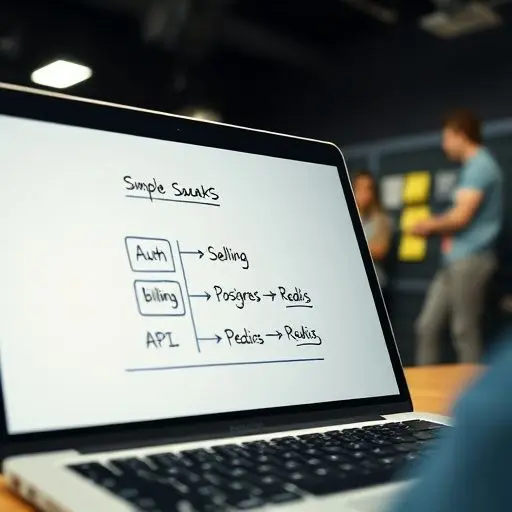
Shortlist two or three sane stack options
Instead of creating a long shopping list, narrow to two or three realistic stacks that meet your constraints. We usually present founders with options like:
- JavaScript full stack: React + Node. js + PostgreSQL on managed services (fast hiring, large ecosystem)
- Python stack: Django + React or Vue + Postgres (batteries-included, good for complex business logic)
- Serverless/managed: Next. js/Remix + Firebase or Supabase (rapid prototyping, low ops)
For each option, capture pros and cons in a one-page memo: learning curve, hiring market, expected dev velocity, and operational overhead. When we built an invoicing SaaS, the team chose Django because of built-in admin and fewer unknowns, letting them reach paid trials in 8 weeks.
Compare stacks on what matters for early-stage
Early-stage compares differently than enterprise. Evaluate:
- Learning curve: How fast can your team be productive? We prefer tools where a single engineer can confidently own the stack for months.
- Hiring pool: Can you hire replacements or contractors quickly if needed?
- Speed of Development: How many features per sprint? Consider frameworks with strong conventions and scaffolding.
- Hosting and ops: Managed DBs, platform features, and backup processes reduce time spent on infrastructure.
In one project, choosing a managed Postgres with built-in backups saved two weeks of ops work and prevented a costly data-restore incident later.
Plan for the first 18 months, not forever
Your stack should scale to cover expected growth in the next 12 – 18 months without requiring a rewrite. We tell founders: design for incremental scalability. Build modular code, keep API contracts explicit, and document data migrations.
If you expect a sudden user growth spike, prioritize horizontal-scaling-friendly services (stateless app servers, cached layers). If you need to iterate on product-market fit first, accept short-term tech debt in isolated places you can refactor later.
For deeper reading on practical selection steps and a decision framework we use for SaaS builds, check our post about how to choose the right technology stack for your SaaS web application – it complements this checklist with concrete decision matrices.
Get a second opinion before you commit
Before you lock a stack, get an experienced engineer or CTO-level advisor to review your shortlist. Ask them to do a 90-minute technical audit focusing on assumptions, failure modes, and migration costs. Our team has found two key benefits to this step:
- It surfaces hidden operational costs (for example, vendor limits on backups or multi-region support).
- It helps estimate the real hiring cost and ramp time for developers.
When a founder skipped this step on a prior project, they discovered mid-build that their chosen identity provider couldn’t support required SSO flows, costing weeks to pivot.
Lock the stack and move on to building
Once you’ve documented the decision (reasons, rejected alternatives, migration notes), stop revisiting it weekly. Create a lightweight onboarding doc for new devs with diagrams, CI setup, and a “why we chose this” section. That clarity stops bike-shedding and keeps velocity high.
Our playbook: pick a default template repo, configure CI/CD, deploy a minimal staging environment, and ship an end-to-end happy path in the first two sprints. Re-evaluate major changes only at meaningful milestones (e. g., after reaching 1, 000 MAU or securing bridge funding).
Final checklist founders can use today
- Define product scope and non-negotiables (compliance, integrations)
- Map team skills and hiring constraints
- Make a jobs list for the stack (auth, billing, data, APIs, admin)
- Shortlist 2 – 3 stacks with pros/cons
- Run a 90-minute technical sanity check with a senior engineer
- Document the decision and ship the first major user flow
Frequently Asked Questions
How long should I expect to evaluate and lock a stack?
From our projects, a focused evaluation takes 1 – 2 weeks: discovery, shortlist, and an external sanity check. Dragging the decision longer usually delays product learning and increases costs.
When is it worth choosing a niche language for performance?
Only when performance is core to your value proposition (e. g., realtime low-latency systems) and you can hire or fund the necessary expertise. We’ve seen early rewrites blow runway when performance was only an assumed future need.
Can I mix serverless and traditional servers?
Yes – hybrid architectures are common. Use serverless for bursty or event-driven parts, and reserve managed servers/containers for steady-state APIs. Ensure clear boundaries so you can migrate pieces later if needed.
What’s the best way to document the decision?
Keep a one-page decision record with context, trade-offs, rejected options, and migration notes. Pair that with a repo README that gets developers productive in one hour – we do this for every client project to reduce onboarding time.