Most businesses that end up with a slow, broken, or underperforming WordPress site did not make a bad choice of platform. They made a bad choice of partner.
WordPress itself is not the problem. It powers 42.2% of all websites as of 2026 and remains one of the most flexible and scalable platforms available for businesses of any size. The problem is almost always how it was built, who built it, and whether that person or agency actually understood the business behind the website.
This guide is written for business owners who are in one of three situations: you need a new WordPress site built properly from the start, you are on Wix, Squarespace, or another platform and want to move to WordPress, or you already have a WordPress site that is not performing the way it should. In all three cases, the most important decision you will make is who you hire to do the work.
Why the Partner Matters More Than the Platform
WordPress gives you a strong foundation, but it does not build itself. A clean WordPress site with proper hosting, a lightweight design, strong SEO structure, and clear calls to action can work very well. A bloated WordPress site with too many plugins, oversized images, and no strategy can feel slow and outdated.
The difference between those two outcomes is almost entirely the team that built it.
A good WordPress development partner does not just write code. They ask about your business goals before they talk about design. They plan the site structure around how your customers actually search and navigate. They build with future growth in mind, so adding a new service page or a new feature six months later does not require rebuilding everything from scratch. And they stay available after launch, because a website is never truly finished.
A bad partner does the opposite. They start with a template, fill it with your content, hand it over, and disappear.
Knowing the difference before you sign a contract is what this guide is about.
If You Need a New WordPress Site Built
The most common mistake business owners make when commissioning a new website is focusing on how it looks before thinking about what it needs to do.
A website is not a brochure. It is a business tool. Every design decision should serve a function: getting visitors to contact you, understand your services, trust your credibility, or take a next step. When you start with aesthetics and work backwards to functionality, you end up with a site that looks impressive in a presentation but does not convert visitors into enquiries.
Before any development begins, a serious partner will want to understand:
- Who your customers are and what they search for before they land on your site
- What action you want visitors to take, and where on the site you want them to take it
- What your competitors are doing well and where there is a gap you can own
- How you plan to manage and update the site after launch, and whether the build should account for that
If a development partner jumps straight to wireframes or design concepts without asking these questions, that is a warning sign.
What to look for in a new build partner:
A track record of sites built for businesses similar to yours in size or sector. References you can actually contact. A clear scoping process before any design work starts. Transparent pricing that does not balloon after the project begins. And a defined approach to SEO from day one, not as an add-on at the end.
If You Want to Migrate from Another Platform
Businesses on Wix, Squarespace, Shopify, or a custom-built site often reach the same point: the platform they started on made sense when they were small, but it is now limiting what they can do.
WordPress is usually the better choice when your site needs SEO content, custom pages, service funnels, local landing pages, or stronger long-term performance. The flexibility it offers, both for developers and for the business owners managing content after launch, is hard to match on a closed platform.
But migration done badly is worse than not migrating at all. The risks include losing search rankings you have built up over time, broken links that send visitors to error pages, missing or duplicated content, and a site that looks different enough from the original to confuse returning customers.
A competent migration partner manages all of these risks as part of the process:
- Redirect mapping: Every URL on your old site should be mapped to its equivalent on the new WordPress site, with 301 redirects in place from day one so search engines transfer the ranking value you have earned.
- Content migration: All pages, blog posts, images, and metadata should transfer cleanly, not be rebuilt from scratch with guesswork.
- SEO preservation: Title tags, meta descriptions, header structures, and internal links should all be reviewed and carried across, not left to default values.
- Testing before launch: The new site should be fully tested on a staging environment before it goes live, covering browser compatibility, mobile display, form submissions, page speed, and any third-party integrations.
- What to ask a migration partner: Ask them to walk you through their migration process step by step. Ask specifically how they handle redirects and SEO preservation. If they cannot give you a clear answer, they have either not done many migrations or they are planning to wing it.
If Your Existing WordPress Site Is Broken or Underperforming
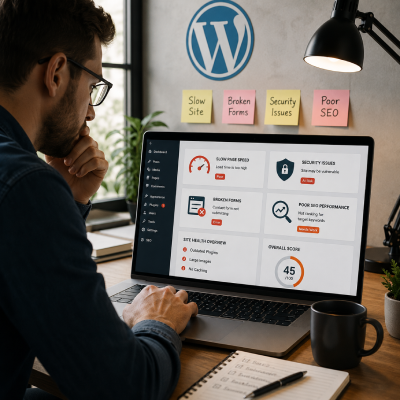
This is the most frustrating situation of the three, because the problems are usually invisible until they are serious. A site that loads slowly, loses leads through broken forms, gets hacked due to outdated plugins, or simply fails to rank for anything useful is costing you money every day it stays that way.
The good news is that most WordPress problems can be fixed without rebuilding the entire site. The bad news is that diagnosing them properly requires genuine technical expertise, not just someone who knows how to update plugins.
Common problems and what they actually require:
- Slow page speed: Usually caused by unoptimised images, too many poorly coded plugins, cheap hosting, or missing caching. Fixable without a rebuild in most cases, but requires someone who understands performance optimisation at a technical level, not just installing a speed plugin and calling it done.
- Security issues or hacking: Outdated WordPress installations are the primary source of security breaches that take small business sites offline or turn them into vehicles for malware. Budgeting for proper maintenance from day one is not optional. If your site has already been compromised, you need a partner who can clean it thoroughly and put proper security measures in place, not just restore a backup and hope it does not happen again.
- Poor SEO performance: If your site is not appearing in search results for terms your customers actually use, the causes could be technical (incorrect indexing settings, missing schema, duplicate content) or content-based (pages that do not target the right keywords, thin content that search engines do not find useful). A proper SEO audit identifies which it is before any work begins.
- Broken functionality: Contact forms that do not submit, e-commerce checkouts that fail, booking systems that misbehave. These are almost always caused by plugin conflicts or outdated integrations and can usually be resolved without a full rebuild.
- What to ask a repair and improvement partner: Ask them to start with an audit before they quote for any work. A partner who quotes for fixes without first understanding the full picture of what is wrong is guessing. An audit, even a paid one, will save you money in the long run.
5 Questions to Ask Any WordPress Development Partner
Regardless of which situation you are in, these five questions will tell you quickly whether a partner is worth hiring.
1) Can you show me examples of WordPress sites you have built for businesses similar to mine?
Not a portfolio page with screenshots. Actual live URLs you can visit and test yourself.
2) What does your process look like from scoping call to launch?
A serious partner has a defined process with clear stages. Vague answers here suggest they are making it up as they go.
3) How do you handle scope changes during the project?
Projects always evolve. The answer should describe a clear process for flagging changes and discussing impact on timeline and cost, not a flat no or a blank cheque.
4) What happens after the site launches?
Do they offer ongoing support? Do they hand over full access and disappear? Do they have a maintenance package? There is no single right answer, but you need to know what you are signing up for.
5) Do you use in-house developers or freelancers?
Freelancer-based teams are not always bad, but they introduce communication gaps and continuity risk. An in-house team that has worked together on many projects brings a level of coordination that matters especially on complex builds or migrations.
What Zluck Brings to WordPress Projects
At Zluck, we have been building custom WordPress sites since 2014. Our in-house team of 40+ engineers and designers handles the full project lifecycle: scoping, design, development, QA, launch, and post-launch support. We do not use freelancers and we do not hand projects off mid-way.
We work with three types of WordPress clients: businesses starting from scratch who need a site built properly the first time, companies migrating from Wix, Squarespace, or other platforms who want to do it without losing their search rankings, and businesses with an existing WordPress site that is slow, broken, or simply not generating results.
In every case, we start with a free consultation where we understand your business, your goals, and what a successful site actually looks like for you before we talk about design or timelines.
If you are ready to talk about your WordPress project, book a free consultation with our team. It takes 30 minutes and you will leave with a clear picture of what the right approach looks like for your specific situation.
Frequently Asked Questions
How long does it take to build a WordPress site for a small business?
A well-scoped small business WordPress site typically takes 4 to 8 weeks from scoping to launch. The timeline depends on the number of pages, the complexity of any custom functionality, and how quickly feedback and approvals come from your side. At Zluck, we give you a clear timeline estimate after the scoping call, before any work begins.
How much does custom WordPress development cost?
A custom WordPress site for a small business typically ranges from $5,000 to $20,000 depending on scope, number of pages, custom features, and integrations. Template-based builds cost less but come with limitations on design flexibility and scalability. At Zluck, we scope every project individually and give you a clear fixed-price estimate before we start.
Can you migrate my site from Wix or Squarespace to WordPress without losing my Google rankings?
Yes, if the migration is handled correctly. This means mapping all your existing URLs to their new equivalents, setting up 301 redirects, preserving your metadata, and testing thoroughly before launch. We handle the full migration process and have done this for many clients who came to us specifically because a previous agency had done it badly.
My WordPress site is slow and broken. Do I need to rebuild it completely?
Not always. In most cases, the issues can be diagnosed and fixed without starting from scratch. We start every repair engagement with a full audit of the site to identify exactly what is causing the problems, then give you a clear recommendation on whether fixes or a rebuild is the more cost-effective path for your situation.