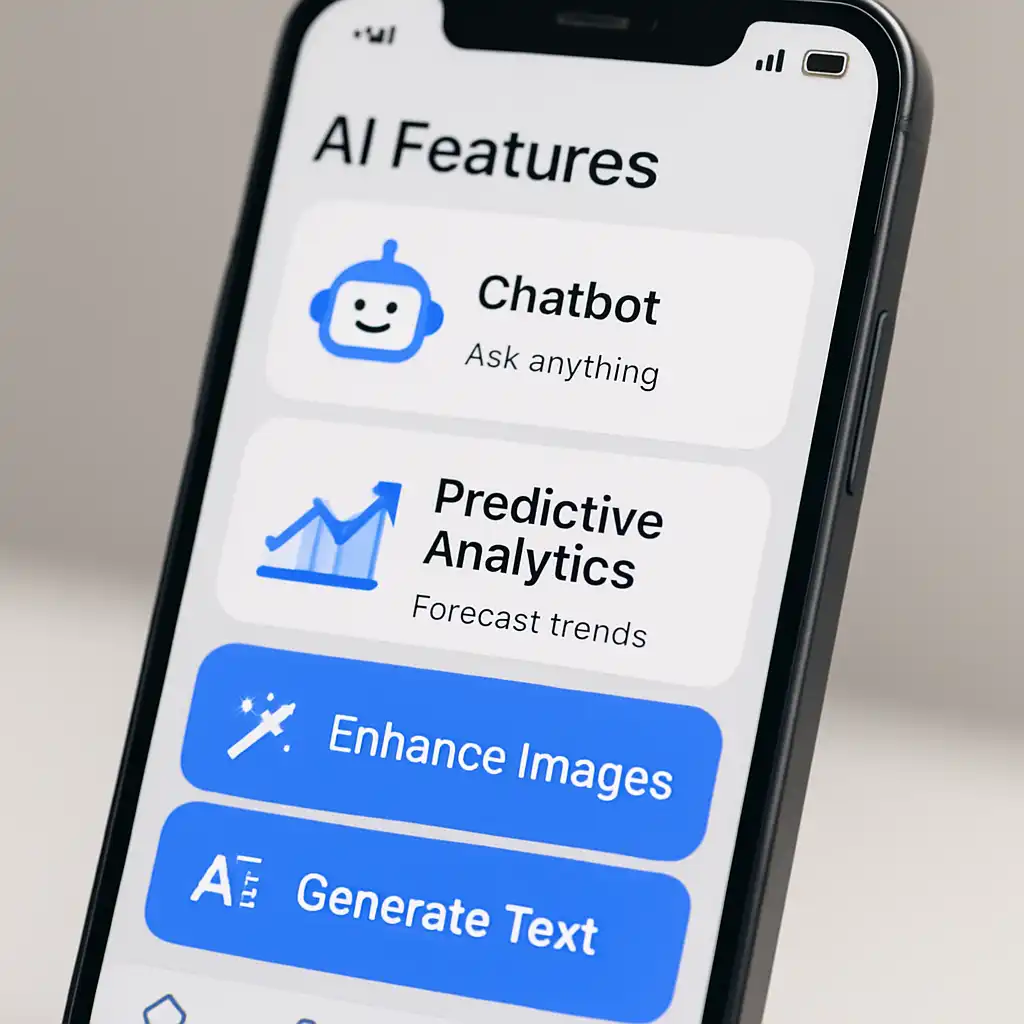
You have the funding. You have the idea. Now you need a working product in the market as fast as possible without burning half your runway on a build that misses the point.
This guide is written for funded founders who are thinking about building an AI-powered MVP. We will cover what AI in an MVP actually means, what decisions you need to make before a single line of code is written, what realistic timelines and costs look like in 2026, and how to choose the right development partner.
No fluff. Just what you need to make a good decision.
What Makes an MVP “AI-Powered” (& What It Is Not)
An AI-powered MVP is not a product that uses AI as a feature list item to impress investors. It is a product where AI solves a real user problem in a way that would not be possible, or would be significantly worse, without it.
Examples of genuine AI in an MVP:
- A document review tool that uses an LLM to extract key clauses and flag risks automatically
- A customer support product that routes and responds to tickets using a fine-tuned model trained on your domain
- A recommendation engine that personalizes content or products based on real-time user behavior
Examples of AI that is not worth building into a first MVP:
- A chatbot that just wraps GPT-4 with a custom prompt and adds no proprietary logic
- A dashboard with “AI-generated insights” that are too generic to act on
- Any AI feature where a simple rule-based system would do the same job
The test is simple: does the AI create a meaningfully better outcome for the user, and is that outcome tied to your core value proposition? If yes, build it in from day one. If no, ship the core product first and layer AI in later.
When Does a Funded Startup Actually Need AI in the MVP?
Not every funded startup needs AI in version one. Here is a straightforward way to think about it.
Build AI into the MVP if:
- Your product’s core value depends on processing large amounts of unstructured data (text, audio, documents, images)
- Personalization at scale is the primary thing that makes your product better than existing alternatives
- You need to automate a decision or workflow that currently requires a human expert
- Your investors and target users both expect the product to be AI-native from day one
Wait & add AI later if:
- Your core user problem can be solved with straightforward logic and a good UI
- You do not yet have enough real user data to train or fine-tune a model meaningfully
- Adding AI would require 3 to 4 months of extra build time that your runway cannot support
The honest answer is that many great SaaS products launched without AI and added it in the second or third version once they had real usage data. If your AI feature depends on user behavior to improve, it is often better to get real users first.
4 Decisions to Make Before You Write a Single Line of Code
These are the decisions that most founders skip, and most failed AI MVPs can be traced back to skipping at least one of them.

1) What is the one problem the MVP must solve?
Not three problems. Not a platform. One problem, for one type of user, solved well enough that they would pay for it or tell someone else about it. Every feature decision in the build flows from this answer.
2) Which AI component actually needs to be custom, and which can use an API?
Most AI MVPs do not need a custom-trained model. OpenAI, Anthropic, Google Gemini, and open-source models like Llama handle the majority of language tasks well out of the box. What often does need to be custom is the surrounding logic: how you retrieve context, how you structure prompts, how you handle edge cases, and how you manage data privacy. Know the difference before you scope the budget.
3) What data do you have, and is it ready?
AI quality depends on data quality. If your product relies on user data that does not yet exist, you need a plan for how you will collect it, structure it, and use it in the model. This should be part of the architecture from day one, not an afterthought after launch.
4) What does “done” look like for the MVP?
Define the smallest version of the product that lets you answer your most important business question. That question is usually: will users pay for this, and do they keep coming back? Everything outside that definition is a post-launch feature.
What a Realistic AI MVP Timeline & Cost Looks Like in 2026
Here is what funded founders can expect when working with an experienced development partner.
Timeline:
| MVP Type | Typical Timeline |
| AI integration added to an existing product | 4 to 8 weeks |
| AI-native product built from scratch (focused scope) | 8 to 12 weeks |
| AI-native product with complex integrations or custom model work | 12 to 16 weeks |
The biggest variable is scope clarity. Teams that come in with a well-defined problem and a clear definition of done ship significantly faster than teams that are still deciding what to build during the development phase. A structured scoping process before development starts is not optional, it is what makes the timeline predictable.
Cost:
| MVP Type | Typical Range |
| Focused AI MVP with a clear scope | $15,000 to $40,000 |
| AI-native product with multiple integrations | $40,000 to $80,000 |
| Complex AI platform with custom model components | $80,000 and above |
These are ranges based on working with funded startups at various stages. The exact number depends on the number of features, the complexity of the AI component, the number of integrations, and whether the product includes both a backend and a marketing-facing front end.
One thing worth saying directly: the cheapest option is rarely the right option for an AI product. AI development requires engineers who understand model behavior, prompt engineering, data handling, and performance tradeoffs. That expertise has a cost, and cutting it at the MVP stage tends to create a codebase that cannot scale.
How to Choose the Right Development Partner for an AI MVP
Most development agencies will tell you they build AI products. Here is how to tell who actually does.

Ask them to explain a past AI project without using buzzwords. A team that has built real AI products can walk you through the specific technical decisions they made: which model they chose and why, how they handled context and retrieval, what went wrong and how they fixed it. A team that has not will give you a generic description.
Ask how they handle scope changes. AI projects surface unexpected complexity mid-build more often than traditional software projects. The right partner has a clear process for flagging scope changes early and giving you options, not surprises on the final invoice.
Ask about post-launch support. AI systems need monitoring. Model outputs drift over time, edge cases appear in production that were not visible in testing, and your users will find ways to interact with the product you did not anticipate. A partner who disappears after launch is the wrong choice for an AI product.
Check whether they use freelancers. AI projects require tight communication between the engineer writing the model logic and the engineer building the product around it. Distributed freelancer teams with no shared context make this difficult. An in-house team with continuity is a meaningful advantage.
What Our Process Looks Like at Zluck
At Zluck, every AI MVP engagement starts with a free scoping call where we map the core user problem, identify the right AI components for the first version, and give you a clear timeline and cost estimate before any work begins.
From there, a dedicated in-house team handles design, development, AI integration, QA, and launch. You get weekly updates, full visibility into progress, and a team that stays with you after launch for support, iteration, and scaling.
We have been building software since 2014 and have spent the last several years specifically focused on AI-powered products for funded startups in the US, UK, and EU. Our typical AI MVP ships in 8 to 12 weeks.
If you are ready to scope your MVP, book a free call with our team. It takes 30 minutes and you will leave with a clearer picture of what to build, what it will cost, and how long it will take.
Frequently Asked Questions
Not always. Many AI MVP features use pre-trained foundation models like GPT-4 or Claude that do not require your own training data. What you do need is a clear plan for how the model will access relevant context, whether that is through retrieval-augmented generation, structured prompts, or user-provided input. Your development partner should help you map this out in the scoping phase. Yes, if it is built correctly from the start. This means using a modular architecture, clean API design, and code structure that allows new features to be added without rebuilding the foundation. At Zluck, we design every MVP with the post-launch roadmap in mind, so the first version is a foundation, not a dead end. That is expected. The purpose of an MVP is to learn from real users and adjust. What matters is that the codebase is clean enough to pivot quickly without starting over. This is why the architecture decisions in the scoping phase matter as much as the features themselves. You should plan for a weekly check-in and be available to answer questions as they come up, especially in the first two weeks when most of the key decisions are being made. Beyond that, a good development partner handles the execution and flags decisions that need your input rather than asking you to manage the project yourself.Do I need a large dataset to build an AI MVP?
Can the MVP be scaled into a full product later without rebuilding it?
What if my idea changes after the MVP launches?
How involved do I need to be during the build?